Revenue Operations Insights
What Does a Revenue Operations Audit Look At?
A revenue operations audit traces a business problem across marketing, sales, and customer success. It examines how the work happens, what systems capture, how reliable the data is, and which decisions the reporting supports. The result should tell leaders what to fix first, who should own it, and how to measure progress.
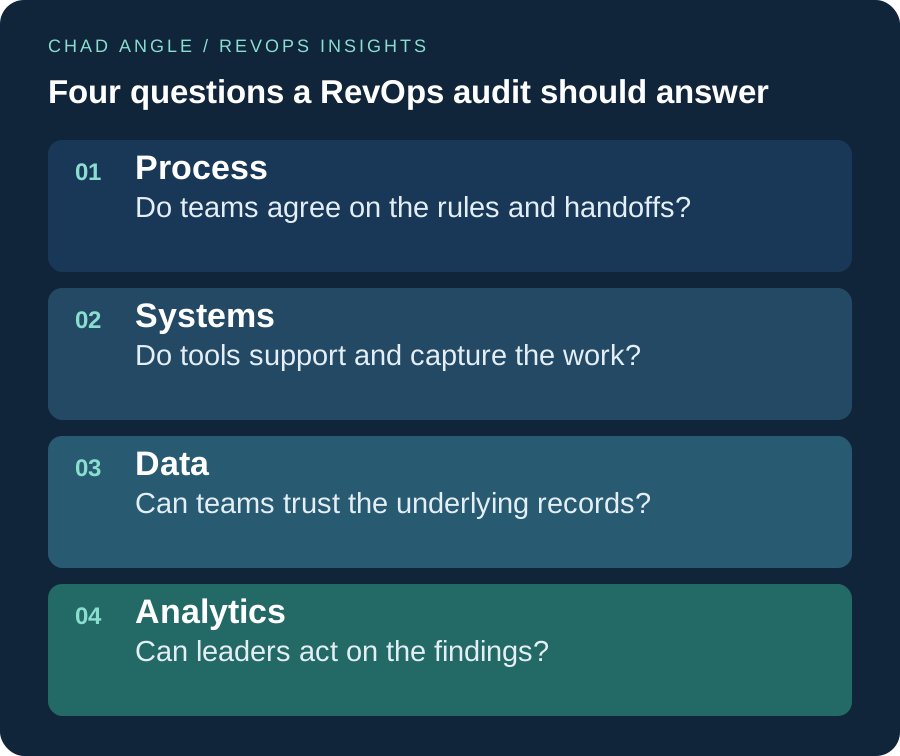
- ProcessDo teams agree on the rules and handoffs?
- SystemsDo tools support and capture the work?
- DataCan teams trust the underlying records?
- AnalyticsCan leaders act on the findings?
Begin with a decision
Choose a decision the executive team is struggling to make. Should we add sales capacity, change our marketing spend, or rebuild part of the process? That question tells you which records, interviews, and operating reviews to examine first.
Follow a sample through the funnel
Take a sample of recent opportunities and trace each one back to its source and forward to the outcome. Compare routing, stage changes, next steps, and CRM field completion. Check whether the written process matches what people actually do, including cases that were rejected, stalled, or reassigned.
Separate the finding from the recommended fix
A report may show slow follow-up. The cause could be routing, unclear ownership, capacity, or a timestamp that measures the wrong event. Validate the cause before funding an automation. Record what the data supports and where a follow-up check is needed.
What should leadership get back?
Ask for the evidence, a ranked list of changes, dependencies, a named owner, and a measure of improvement. The DRIVE Assessment is one way to get that starting point. A team that already knows it needs ongoing ownership can use a diagnostic to set the first priorities within that engagement.