Revenue Operations Insights
What PE Operating Partners Should Review in the First 90 Days After Close
In the first 90 days after an acquisition, test the commercial assumptions behind the deal, agree on a reliable baseline, and give the highest priority fixes owners. Start with the assumptions that most affect the investment thesis and can be tested with the information available.
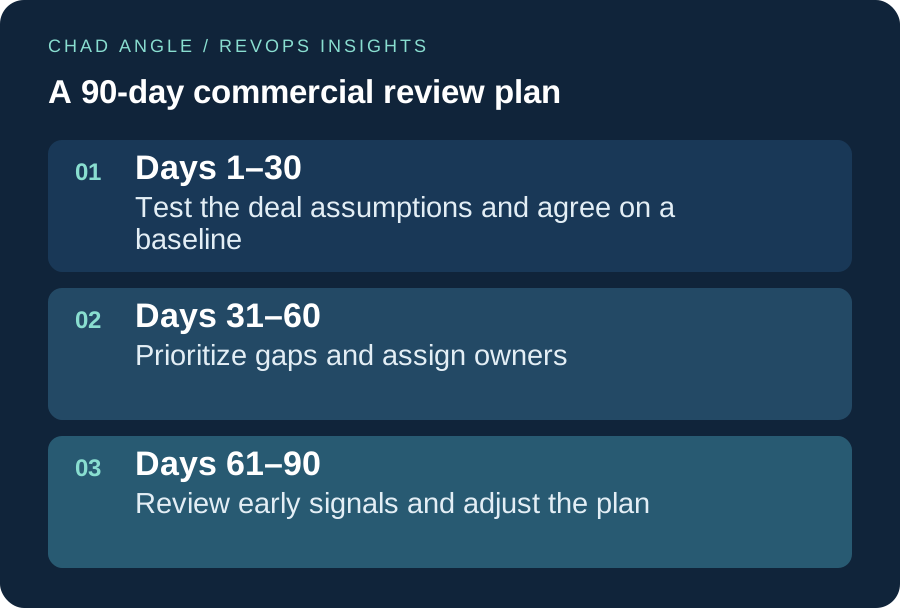
- Days 1–30Test the deal assumptions and agree on a baseline
- Days 31–60Prioritize gaps and assign owners
- Days 61–90Review early signals and adjust the plan
Days 1–30: make the assumptions testable
Turn the growth plan into a short list of assumptions about conversion, sales cycle, pricing, retention, or capacity. For each, write down the source, owner, and what would change your view. Agree on definitions with management and finance before comparing metrics across periods.
Days 31–60: choose what to fix first
Rank the gaps by impact, urgency, and dependencies. If the thesis depends on faster sales cycles, check where deals wait and whether the CRM records those stages consistently. Give the first changes to named owners with agreed dates and review measures.
Days 61–90: check whether the evidence is changing
Use the operating review to check early signals and track which assumptions still hold. Use leading indicators such as qualified pipeline creation or buyer next steps alongside lagging outcomes such as bookings and retention. Keep a record of changes to definitions or source data.
What should the sponsor see?
A compact scorecard can show the assumption, current evidence, remaining uncertainty, owner, and next decision. Management can use the same scorecard to surface problems early. The timeline is an illustrative planning framework and should be adapted to data access and operating priorities.